


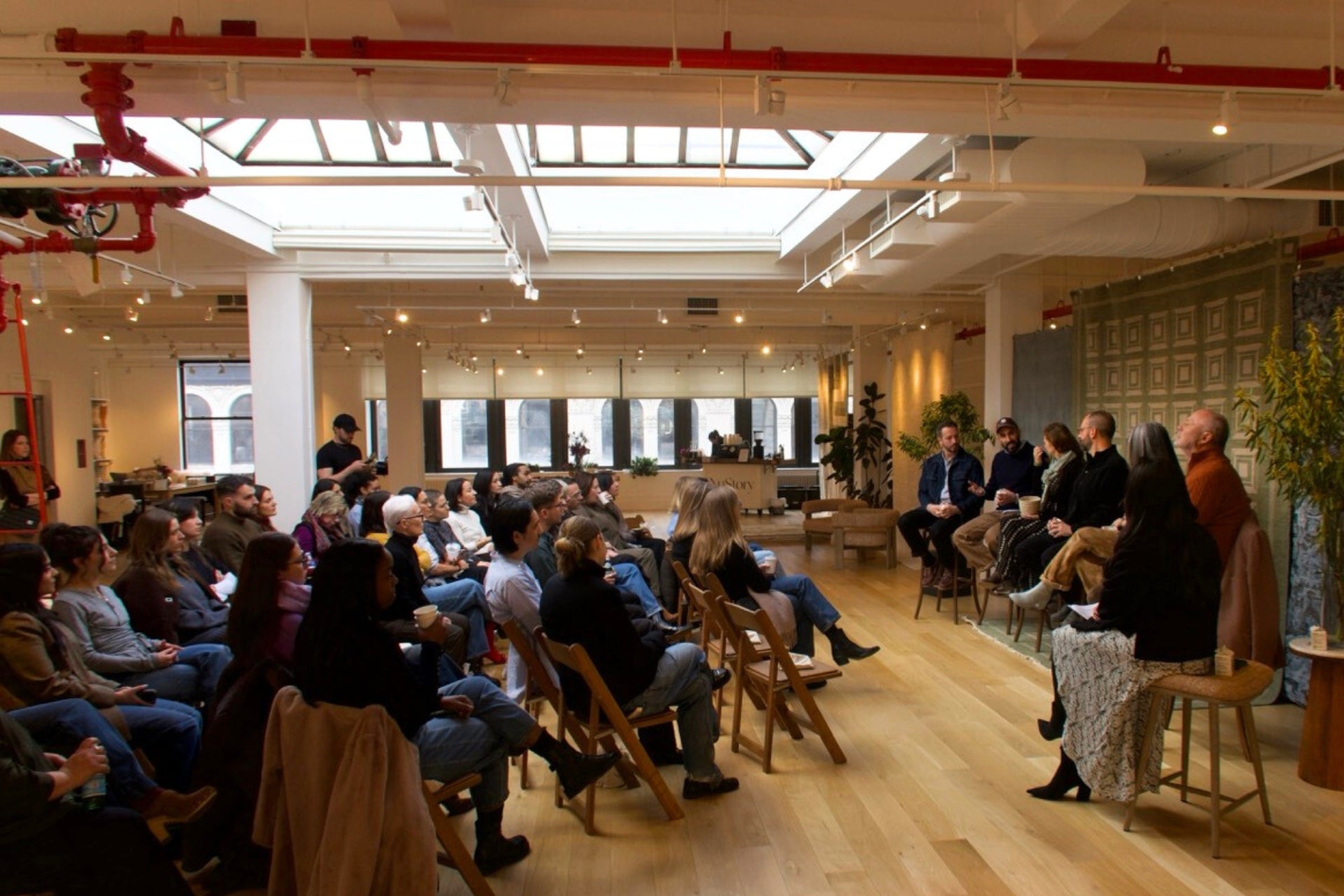
EVENT RECAP: Craft in Conversation- What It Really Takes to Preserve Craftsmanship Today
In an era defined by speed, scale, and convenience, craftsmanship can feel both deeply desirable and increasingly fragile. That tension sat at the heart of our showroom event, Craft in Conversation - a panel discussion that brought together designers, retailers, and artisans to unpack a deceptively complex question: how do we preserve craft—ethically, sustainably, and meaningfully—while still operating in the realities of modern business?

To provide a perspective on this question, we turned to some members of our community:
- Alex Bellos, Founder of Ellis Works and Former President of West Elm
- Michele Varian, Founder of Michele Varian Home
- Jordan Slocum & Barry Bordelon, The Brownstone Boys, Award-Winning Designers
- Lore Defrancq, CEO & Founding Member of Hadithi Crafts
- Graham Head, Former President of ABC Carpets & Home
From restoring 200-year-old Brooklyn brownstones to building global artisan partnerships, the discussion revealed that craftsmanship isn’t a style choice or a marketing angle. It’s a long-term commitment—one that requires discernment, education, and humility.
Craft as Structure, Not Decoration
For Jordan Slocum and Barry Bordelon of the Brownstone Boys, craftsmanship begins long before furniture or finishes are selected. Their work restoring historic New York City townhouses has taught them that the most meaningful investments in craft are often the least visible.
Their philosophy is rooted in prioritization. Structural elements—plaster ceilings, original staircases, millwork, stained glass—are treated as non-negotiables. These are the bones of a home, the elements that cannot be easily replaced once removed. In many cases, restoring them means sacrificing elsewhere, reallocating budget away from things that can be changed over time.

This approach also reframes luxury. Instead of equating luxury with uniform high-end finishes, Jordan and Barry advocate for intentional contrast: pairing handcrafted, heritage elements with simpler or more cost-effective choices where appropriate. Not every fixture or furnishing needs to be heirloom-quality—but the parts you touch every day, and the elements that define a home’s character, should be built to last.
Their experience has also shaped how they educate clients. Through years of sharing restoration work publicly through their social media channels, they’ve built an audience that already understands the value of preservation before a project even begins. Craft, in this sense, becomes a shared language rather than a constant justification.
Scaling Craft Without Hollowing It Out
Few people have navigated the intersection of craft and scale as extensively as Alex Bellos, former president of West Elm and founder of Ellis Works. His perspective was clear: scaling craftsmanship is possible—but only when it’s treated as a core business strategy, not a seasonal story.

One of his central points was the importance of true partnership between designers and artisans. Authentic craft emerges through collaboration and dialogue, not transactional sourcing. Simply “shopping” for handmade goods strips away the nuance that gives them meaning.
Certification also plays a critical role. Without systems of accountability—such as Fair Trade or third-party verification—claims of ethical production are difficult to substantiate. Transparency protects both artisans and consumers, ensuring that “handmade” isn’t just a label, but a reality.
Perhaps most importantly, Alex emphasized that craft must be ongoing to be sustainable. One-off orders, no matter how well intentioned, can destabilize artisan communities. Long-term relationships—sometimes spanning decades—allow for steady income, skill development, and generational continuity. In this model, craft isn’t a limited-edition feature; it’s foundational.
The Artisan Reality: Time, Pride, and Pressure
From the artisan perspective, Lore Defrancq offered a grounding reminder: craftsmanship is constrained by human limits. Handmade work takes time, and pushing timelines or prices too aggressively doesn’t just impact output—it impacts dignity and quality.

As demand increases, artisans face a complex set of pressures. Scaling volume can improve livelihoods, but only if growth is paced responsibly. Sudden spikes in demand can force compromises, strain communities, or create unsustainable expectations.
Lore also highlighted a common misunderstanding among designers and brands: not everything is easily customizable. While color changes may be straightforward, alterations in size, shape, or material often carry structural implications. Clear communication—about what can and cannot change—is essential to protecting both the craft and the maker.
Importantly, Lore pointed to the opportunity embedded in long-term investment. When artisans are supported consistently, quality improves through repetition, and younger generations begin to see craft as a viable future rather than a fading tradition. Preservation, in this sense, isn’t nostalgic—it’s economic.
Tariffs, Transparency, and Shared Responsibility
Designer and retailer Michele Varian addressed one of the most pressing realities facing the industry today: tariffs and sourcing instability. Her message was candid—there are no easy solutions, only thoughtful trade-offs.

To mitigate risk, her business took proactive steps, from pre-purchasing inventory to exploring cross-border warehousing solutions. But beyond logistics, she stressed the importance of transparency. Absorbing rising costs entirely may shield consumers in the short term, but it also obscures the true impact of policy decisions on small manufacturers and artisans.
Instead, Michele argued that consumers must become part of the equation. Educating customers about why prices shift—and who is affected when margins are squeezed—helps build trust and shared accountability. Craft cannot survive if its true cost is hidden.
Selling Craft Is About Story, Not Status
Few voices carry as much authority on selling craftsmanship as Graham Head, whose decades at ABC Carpet helped shape how handcrafted rugs and antiques are presented to modern consumers.

His perspective was refreshingly long-term. Economic cycles, political disruptions, and technological shifts come and go. What endures are businesses built on passion, clarity, and conviction.
For Graham, helping consumers appreciate craft isn’t about justifying higher prices—it’s about storytelling. When people understand the human impact behind a product, when they see how craft sustains communities and preserves knowledge, value becomes intuitive.
He also drew a compelling parallel between today’s AI-driven moment and past industrial revolutions. Just as mass production once sparked the Arts & Crafts movement, today’s digital acceleration may lead consumers back toward objects with soul—things that feel human, imperfect, and grounded.
Craft, Art, and the Question of Value
The panel closed with a nuanced discussion around the often-debated line between art and craft. Is craft defined by function? Is art defined by non-utility? Or does that distinction no longer serve us?
The consensus leaned toward irrelevance. Whether a rug hangs on a wall or lives underfoot, its value lies in the depth of knowledge, skill, and intention embedded within it. High craft carries cultural memory. It reflects centuries of experimentation, problem-solving, and beauty-making. That worth exists regardless of category.
The One Choice That Matters Most
Across every perspective, one theme remained constant: commitment over convenience.
Preserving craftsmanship doesn’t require perfection or unlimited budgets. It requires choosing long-term partnerships over short-term gains, education over aesthetics, and respect over efficiency. Whether you’re a designer, brand, or consumer, the most impactful decision is often the simplest one—to slow down, ask questions, and invest with intention.
Because craft, at its core, is not about what we consume. It’s about what we choose to sustain—the makers, the methods, and the communities that keep this work alive.
Join Us: Trade Program + Future Craft Conversations
 If you’re an interior designer, architect, or trade professional who believes in building spaces with handcrafted products, we’d love to welcome you into the NuStory community.
Join our list for future events like Craft in Conversation—where we gather designers, artisans, and industry leaders to keep the conversation (and the craft) moving forward.
Ready to get started? Apply for a trade account and join the community today.

Read more
Designer Stories: Michael DeChillo of Sample House
For Michael DeChillo, design has never been a straight line—it’s been a series of intuitive pivots guided by curiosity, craft, and community. With a background that spans furniture e-commerce, bran...
Read more
Designer Stories: Katie Jacobs of Katie Lee Interiors
Here at NuStory we love to spotlight rising design talent and we are thrilled to sit down today with Katie Jacobs of Katie Lee Interiors. Before launching her New York-based interior design firm,...
Read more